· 7 min read
How to Get Your Part 107 Drone License in 2026
Eligibility, the knowledge test, IACRA, costs, and how long it takes, step by step.
In short: To get an FAA Part 107 remote pilot certificate (the "drone license"), you must be at least 16. You get an FAA Tracking Number in IACRA, pass a 60-question knowledge test at an FAA-approved testing center, then apply in IACRA and clear a TSA background check. Most people finish in 3 to 10 weeks. The required costs are about $175 for the test plus $5 per drone to register it. You need the certificate any time you fly for money, for a business, or for anything that isn't purely recreational.
Key takeaways
- Who needs it: anyone flying a drone for work, pay, a business, or a client, even once and even for a small fee. Purely recreational flyers need the free TRUST certificate instead.
- Who can get it: you must be 16 or older, read, speak, write, and understand English, and be in physical and mental condition to fly safely. No medical certificate is needed, and you don't have to own a drone.
- The hard part is the knowledge test: 60 multiple-choice questions, 2 hours, 70% to pass, in person at a testing center. Airspace and sectional charts are where most people lose points.
- Paperwork after the test: apply in IACRA, a TSA security check runs, and a temporary certificate arrives by email.
- Staying current: free online recurrent training every 24 calendar months. You don't retake the test.
Do you need Part 107?
You need Part 107 if the flight isn't purely for fun. That includes real estate photos, roof or solar inspections, wedding video, mapping a farm, and footage you sell or post for a business. "A friend's business paid me $50" counts too. Hobby flying, with no business purpose and no compensation, falls under the Exception for Recreational Flyers. That route needs the free TRUST certificate, not Part 107.
If you're not sure, ask yourself whether anyone benefits from the flight other than you having fun. If the answer is yes, plan on Part 107.
Step 1: Check that you're eligible
The FAA requires a remote pilot applicant to:
- be at least 16 years old
- be able to read, speak, write, and understand English
- be in physical and mental condition to fly a drone safely
That's the whole list. There's no flight test, no flight-hour minimum, and no medical exam. A 16-year-old high school student can hold the same certificate as a professional inspector.
Step 2: Get an FAA Tracking Number (FTN)
Create an account in IACRA, the FAA's online certification system. It gives you an FAA Tracking Number, which you need to book the test. It takes about 10 minutes. Use your legal name exactly as it appears on your government ID, because the testing center checks that they match.
Step 3: Study for the knowledge test
The test is officially called Unmanned Aircraft General – Small (UAG). The FAA's Airman Certification Standards list what it covers:
- Regulations: Part 107 rules, waivers, Remote ID, operations over people and at night, and accident reporting
- Airspace and charts: airspace classes, reading a sectional chart, and when you need authorization (LAANC)
- Weather: reading METARs and TAFs, density altitude, and how weather affects a small aircraft
- Loading and performance: weight, balance, and load factor
- Operations: airport traffic patterns, radio phraseology, emergency procedures, crew resource management, aeronautical decision-making, and the effects of drugs, alcohol, and fatigue
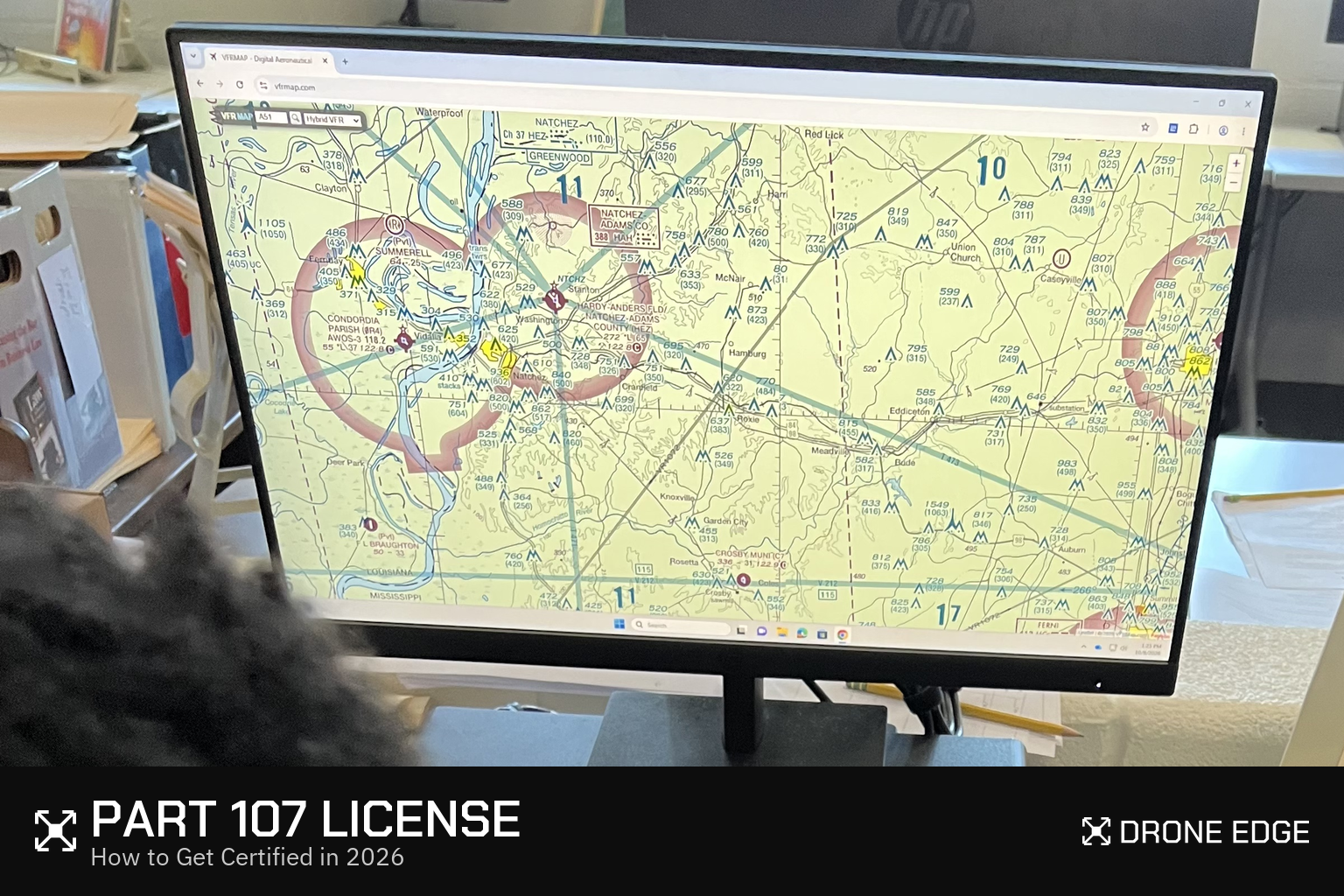
Airspace and chart reading is where most first-time test takers lose points. Here's the kind of question the test asks: on a sectional chart, a dashed blue circle around an airport with [25] in brackets nearby. What does it mean? It means Class D airspace extends from the surface up to 2,500 feet above sea level. To fly a drone inside it, you need ATC authorization, usually through LAANC. Questions like that one are a large share of the test.
How long to study:
| Your background | Typical study time |
|---|---|
| Manned pilot or aviation work | 1–2 weeks (or use the online course in Step 9) |
| Hobby flyer who knows the basics | 2–4 weeks at 5–8 hours a week |
| New to aviation | 4–8 weeks at 5–8 hours a week |
Free and paid options: The FAA publishes free study material, including the Remote Pilot study guide and the testing supplement with the charts used on the test. Some people pass with those alone. A structured course adds lessons in order, practice questions explained one at a time, and practice exams that show which topics you're weak in. Whichever you choose, take full timed practice exams before you book the real one.
Step 4: Book the test
Schedule through PSI, which runs the FAA's knowledge testing centers. You'll need your FTN. The fee is about $175, paid to the testing center. Every prep course, including ours, leaves it out. Many centers book one to three weeks out, so schedule it once you're scoring well on practice exams.
The test is in person only. There's no online or at-home version.
Step 5: Take the test
- Bring a current government-issued photo ID.
- 60 questions, 2 hours, 70% to pass (42 correct).
- You'll get a printed testing supplement with the charts and figures, plus a plotter or straightedge if needed. You may not bring your own notes.
- You get your score before you leave. If you don't pass, you can retake the test after 14 days and pay the fee again.
Step 6: Apply for the certificate in IACRA
About 48 hours after you pass, your 17-digit Knowledge Test ID shows up in the FAA's system. Log in to IACRA, start a new application for Remote Pilot (FAA Form 8710-13), enter the Knowledge Test ID, and sign it electronically.
The TSA then runs a security background check. When it clears, the FAA emails you a temporary certificate you can print and fly with right away. This usually takes a week or two. The permanent plastic card arrives by mail a few weeks later.
Step 7: Register your drone and check Remote ID
Every drone you fly under Part 107 must be registered on FAADroneZone, whatever its weight. It costs $5 per drone and lasts three years. Mark the registration number on the outside of the aircraft.
The drone must also broadcast Remote ID. It can do this through built-in Standard Remote ID, which most new consumer drones have, or through an add-on broadcast module. The other option is to fly only inside an FAA-recognized identification area (FRIA). Check before your first paid flight.
Step 8: Stay current
Your certificate doesn't expire, but your flying privileges do. Every 24 calendar months, complete the free online recurrent training on FAASafety.gov and keep the completion certificate. You don't retake the knowledge test.
Step 9 (for manned pilots only): the shortcut
If you hold a pilot certificate under Part 61 (other than student pilot) and your flight review is current, you don't need the knowledge test. Take the FAA's free online Part 107 course on FAASafety.gov, then apply in IACRA and have your application verified by a flight instructor, an FAA inspector, a designated examiner, or an airman certification representative.
What it costs
| Item | Cost | Required? |
|---|---|---|
| IACRA account and FTN | Free | Yes |
| Knowledge test (paid to the testing center) | About $175 | Yes |
| Drone registration | $5 per drone, every 3 years | Yes, before you fly commercially |
| Recurrent training | Free | Every 24 months |
| Study materials | Free (FAA) to a few hundred dollars for a course | No, but most people use something |
| Remote ID broadcast module | Varies | Only if your drone lacks built-in Remote ID |
The minimum is about $180 if you study with free FAA materials. With a course, budget for the course price plus the test fee.
How long it takes, start to finish
| Stage | Typical time |
|---|---|
| IACRA account and FTN | Same day |
| Studying | 1–8 weeks |
| Waiting for a test slot | 1–3 weeks (study while you wait) |
| Test ID appears, IACRA application | About 2 days |
| TSA check and temporary certificate | About 1–2 weeks |
Where Drone Edge fits
Our Part 107 course follows the order of the topics above. It has structured units, practice questions after each section, unit exams, and full practice exams that show which topics you're weak in. Unit 1 is free, so you can see whether the format suits you before you pay. The full course is $129 (pricing). It doesn't include the FAA test fee, and it doesn't include flight training, because Part 107 has no flight test.
If you're weighing what the certificate is worth, read where drone jobs are in 2026.
Questions answered
How old do you have to be to get a Part 107 license?
16. There's no upper age limit, and no medical certificate is required.
Can I take the Part 107 test online?
No. The initial knowledge test is taken in person at an FAA-approved testing center. Only recurrent training, and the course for current manned pilots, are online.
Do I need to own a drone to get certified?
No. There's no flight test. You need a registered drone only when you start flying under Part 107.
What happens if I fail?
You can retest after 14 days and pay the testing fee again. Your score report lists the topic areas you missed, so study those first.
Does the Part 107 certificate expire?
The certificate doesn't, but you must complete free recurrent training every 24 calendar months to keep flying under it.
Last updated: October 2026. Fees and procedures change. Check the FAA's Become a Certificated Remote Pilot page before you book.
Comments
Loading comments...
Sign in to join the conversation.